
Our Disciplic Succession:


|
"The Sun Never Sets on Sri Chaitanya Saraswat Math":
|
| ABOUT US | GUIDANCE | LIBRARY | DAILY PRACTICE | PHOTO | CALENDAR | CONTACT | বাংলা |
SRI BRAHMA-SAMHITA
Verse 29
chintamani-prakarasadmasu kalpavrksa-
laksavrtesu surabhir abhipalayantam
laksmi-sahasra-sata-sambhrama-sevyamanam
govindam adi purusam tam aham bhajami [29]
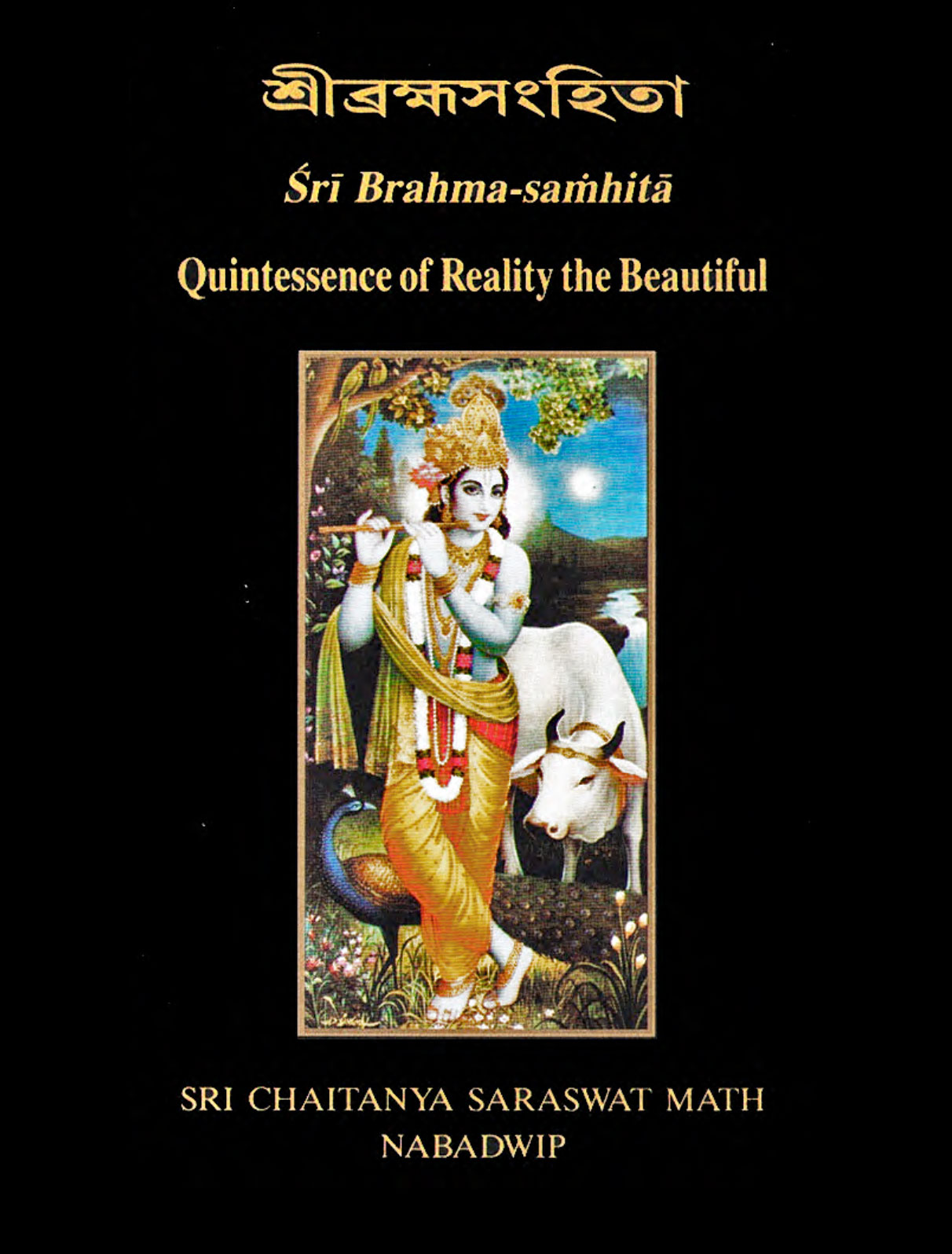
Translation: Surrounded by millions of wish-fulfilling trees, in abodes made of multitudes of wish-yielding gems, He who tends the ever-yielding cows and who is perpetually served with great affection by hundreds of thousands of Laksmis—this Primeval Lord, Govinda, do I worship.
Purport: Here, by the word chintamani, ‘transcendental gem’ is to be understood. As the potency of Maya forms the mundane world from five basic material elements, the divine potency has fashioned the transcendental world from the transcendental element of chintamani. There, the element of chintamani that serves as the structural material of the residence of the Supreme Lord is infinitely more rare and charming than the general chintamani known as a ‘philosopher’s stone.’ The general wish-fulfilling tree yields the fruits of dharma, artha, kama and moksa, or religion, wealth, desire and liberation, whereas the wish-fulfilling trees in Krishna’s abode yield unending fruits of love divine in full variegatedness. The general kama-dhenu, or cows of plenty, give milk as soon as they are milked, whereas from the udders of the cows of Goloka perpetually flows an ocean of the milk that is the fountain of love divine, showering transcendental ecstasy upon the pure devotee jivas, dispelling all their hunger and thirst.
The words laksa-laksa and sahasra-sata, or hundreds of thousands (of Laksmis), indicate infinite multitudes; sambhrama (describing the Laksmis’ service to Krishna) indicates ‘with hearts saturated with love’; laksmi means ‘beautiful cowherd damsels’, or ‘gopis’; and adi-purusa means ‘He who is the origin of all that be.’
•
For Reader's Appreciation
•
Feelings of Appreciation
•
Prologue
•
Translator's Note
•
Illumination
•
Verse 1
•
Verse 2
•
Verse 3
•
Verse 4
•
Verse 5
•
Verse 6
•
Verse 7
•
Verse 8
•
Verse 9
•
Verse 11
•
Verse 12
•
Verse 13
•
Verse 14
•
Verse 15
•
Verse 16
•
Verse 17
•
Verse 18
•
Verse 19
•
Verse 20
•
Verse 21
•
Verse 22
•
Verse 23
•
Verse 24
•
Verse 25
•
Verse 26
•
Verse 27
•
Verse 28
•
Verse 29
•
Verse 30
•
Verse 31
•
Verse 32
•
Verse 33
•
Verse 34
•
Verse 35
•
Verse 36
•
Verse 37
•
Verse 38
•
Verse 39
•
Verse 40
•
Verse 41
•
Verse 42
•
Verse 43
•
Verse 44
•
Verse 45
•
Verse 46
•
Verse 47
•
Verse 48
•
Verse 49
•
Verse 50
•
Verse 51
•
Verse 52
•
Verse 53
•
Verse 54
•
Verse 55
•
Verse 56
•
Verse 57
•
Verse 58
•
Verse 59
•
Verse 60
•
Verse 61
•
Verse 62
•
Verse Contents
Download (epub)
Download (pdf)
Sitemap | Contact us | About us